
Search Green County DUI Records
Green County DUI Records are easiest to track when you start with WCCA, then move to the right county office for the full file. In Green County, that trail can run through the Clerk of Circuit Court in Monroe or Brodhead, the sheriff's office, the district attorney, and the state law library's county resource page. The same case may show up first as a docket entry, then as a request for copies, then as a local law enforcement record. If you know which layer you need, you can save time and avoid asking the wrong office for the wrong document.
Green County Overview
Green County Clerk of Circuit Court
The Green County Clerk of Circuit Court is the main office for circuit court DUI records. The county notes that the clerk provides court forms for civil, criminal, family, traffic, and ordinance cases, handles records management for all case types, and maintains the Civil Judgment and Lien Docket for public access. The office also offers online fee payment, jury information, and interpreter support through a Language Assistance Plan. In a Green County DUI search, that makes the clerk the place where the paper file finally becomes a copy you can request, review, or certify.
The image below comes from the Wisconsin State Law Library's Green County resources page at Green County resources.
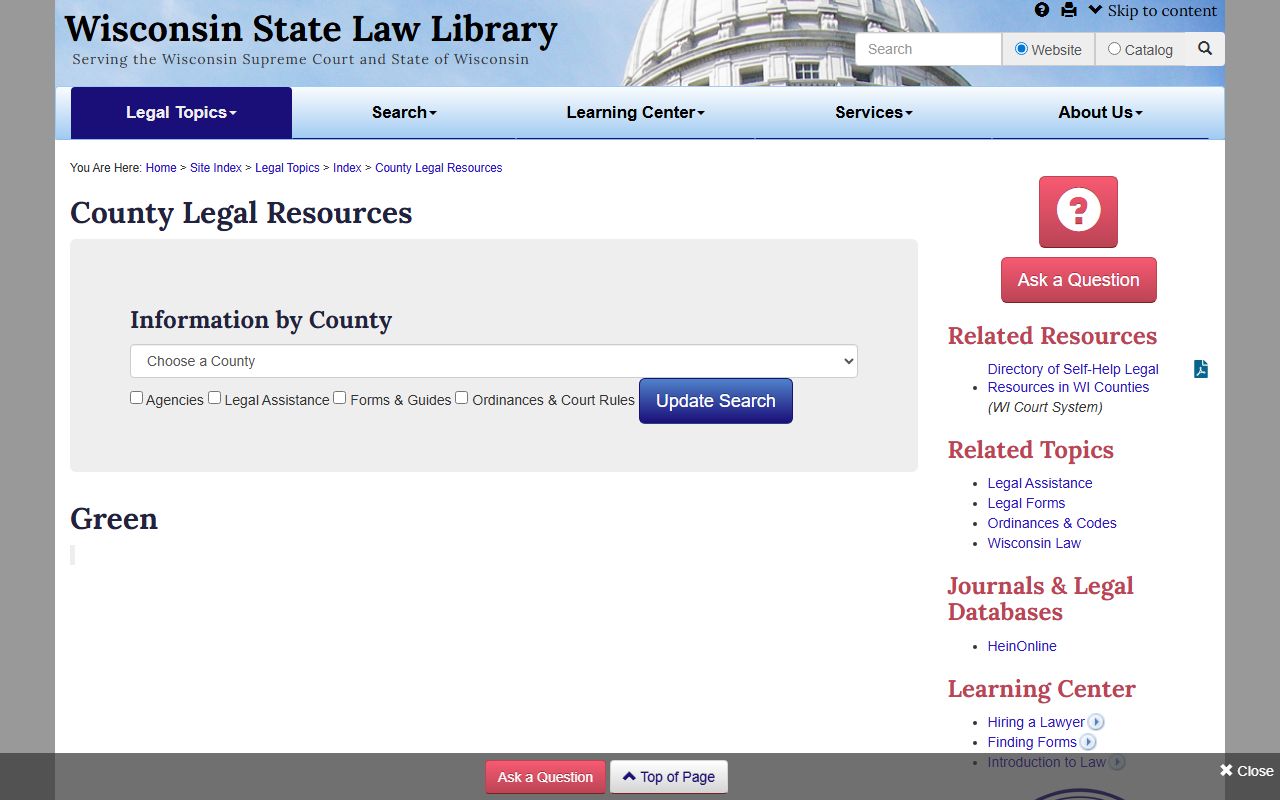
That directory is useful because it places the clerk, sheriff, district attorney, and related county legal contacts in one spot. It gives you a clean path when a DUI search starts with a name, but you still need the office that actually keeps the record.
The clerk can be reached at (608) 328-9433 in Monroe or (920) 294-4142 in Brodhead. Those two numbers matter because Green County splits service across more than one location. If the file is old, the name is common, or the case spans more than one office, the clerk can help you narrow it down before you spend time on the wrong branch. The office can also explain whether you need a certified copy, an uncertified copy, or a records request that includes a search step.
Green County's court records system is not just about the headline charge. It includes civil, family, traffic, ordinance, and criminal files, which means an OWI matter can sit beside related traffic or sanction records that matter later. The Civil Judgment and Lien Docket is also public, so a broader record search can sometimes show related filings that help you understand the case trail. If you only want the docket snapshot, WCCA is enough. If you need the actual paper file, the clerk is the office that keeps it.
Note: The clerk can explain where a record lives and how to request it, but legal advice belongs with an attorney or other qualified adviser.
Green County WCCA Search
The first online stop for most Green County DUI searches is Wisconsin Circuit Court Access. WCCA covers public circuit court case information for criminal OWI cases, civil matters, family cases, and traffic files. It lets you search by party name or case number, so it works well when you are trying to confirm whether a name belongs to a real Green County case before you call the clerk or the sheriff. The docket view is quick, plain, and usually enough to tell you which office to contact next.
WCCA does not replace the court file. It gives you the outline, not the packet. You can see docket activity, case status, and branch information, but not every paper filed with the court. That is why the Green County Clerk of Circuit Court still matters even after you find the case online. Once the docket gives you the case number, the clerk can move much faster on copies, certification, and older records that are not easy to spot by name alone.
When you search, use more than one clue if you have it. A full name is good. A date of birth can help if the docket is crowded. A citation number or filing year is even better. If you are looking at an OWI file from years ago, spelling and middle initials can matter more than people expect. One wrong letter can send you to the wrong person, especially in a county where the same surname can show up more than once.
Bring these details when you search:
- Full name of the defendant or party
- Approximate filing year
- Case number or citation number, if available
- Whether the matter looks like OWI, traffic, or another criminal case
If the case is active, the docket can also help you track the branch and the next court date. If the case is closed, it can still show the final result and where the paper record went. That is the difference between a quick online check and a full record search. WCCA gets you moving. The clerk finishes the job.
Green County Sheriff and DA
The Green County Sheriff's Office is the local place to ask about arrest records, jail operations, warrants, and served legal papers. The county research says the office provides county law enforcement and jail services and executes and serves legal documents and criminal warrants. That makes the sheriff's side important when a DUI search needs more than the court docket. If the stop led to a booking, a bond, or a warrant issue, the sheriff record can explain what happened before the court ever touched the file.
The sheriff's office can be reached at (608) 328-9400 in Monroe or (920) 294-4000 in Brodhead. Those contact points are useful when the case is not just historic but active. A recent arrest may still be moving through booking, release, or service steps, and the sheriff is often the office that can tell you whether the matter is in that stage. If the issue is a warrant, the sheriff's role is even more direct because the office serves and executes those documents.
The Green County District Attorney belongs in the same search path. The district attorney prosecutes criminal cases, including OWI offenses, and the victim/witness program can help with case status information for people who are allowed to receive it. The office can be reached at (608) 328-9424 in Monroe or (920) 294-4046 in Brodhead, with the Green County Victim/Witness Assistance Program at (608) 328-9426. When a DUI case has moved past the arrest stage, the DA is the office that usually shows what the county is doing with the charge.
That split between the sheriff and the district attorney is important. The sheriff shows the law enforcement side, the jail side, and the service side. The DA shows the charging and prosecution side. The clerk shows the official court record. Put those together and Green County DUI Records become much easier to read. You can tell whether you are looking at an arrest, a filed charge, a bond issue, or a finished case.
Green County DUI Follow-Up
State records fill the gap between a local case and the driver's license record. A WisDOT driving record request shows license status, violations, suspensions, and OWI history. The WisDOT OWI suspension page explains revocation periods, occupational licenses, and reinstatement steps. If the question is really about when a person can drive again, the DOT record often matters as much as the county court file.
The Wisconsin State Law Library's drunk driving resources are a good place to check the legal frame behind the record. They gather forms, statutes, and related references in one place. The main offense language is in Wis. Stat. 346.63, and the implied consent and chemical testing rules are in Wis. Stat. 343.305. Those links do not replace the docket, but they help explain why a case file has the steps it does.
The Wisconsin Online Record Check System is another useful follow-up when you need a statewide criminal history check rather than just a single court docket. It does not replace the county file either, but it can help confirm whether a name shows up in a broader criminal record search. If the DUI involved a crash, the WisDOT crash records system can add the accident report layer and show details that never appear in the clerk's docket page.
Green County DUI Records make the most sense when you separate the layers. WCCA gives you the case. The clerk gives you the paper file. The sheriff gives you arrest and warrant details. The district attorney shows the prosecution side. The state systems show the license and legal background. Once you read them in that order, the county record stops feeling scattered.