
Kenosha County DUI Records Access
Kenosha County DUI Records usually start with WCCA, but the county clerk, sheriff, district attorney, and city police records each hold a different piece of the trail. That matters here because Kenosha handles a large volume of criminal traffic and OWI cases, and the first hit online is not always the last record you need. A case number can point to the clerk, an arrest report can point to the sheriff, and a city citation can begin with municipal records. If you sort those paths early, the search gets cleaner and faster.
Kenosha County Overview
Kenosha County Clerk of Courts
The Kenosha County Clerk of Courts can be reached at 262-653-2664. The Wisconsin State Law Library's Kenosha County resources page points to the local court tools that matter most for DUI record work, including Family Court forms, small claims collections procedures, online fee payment, jury information, and the civil, criminal, family, traffic, and ordinance record sets. For a Kenosha County DUI search, the clerk is the office that turns a docket hit into the official circuit court file.
The local image below comes from the same Kenosha County resources page.
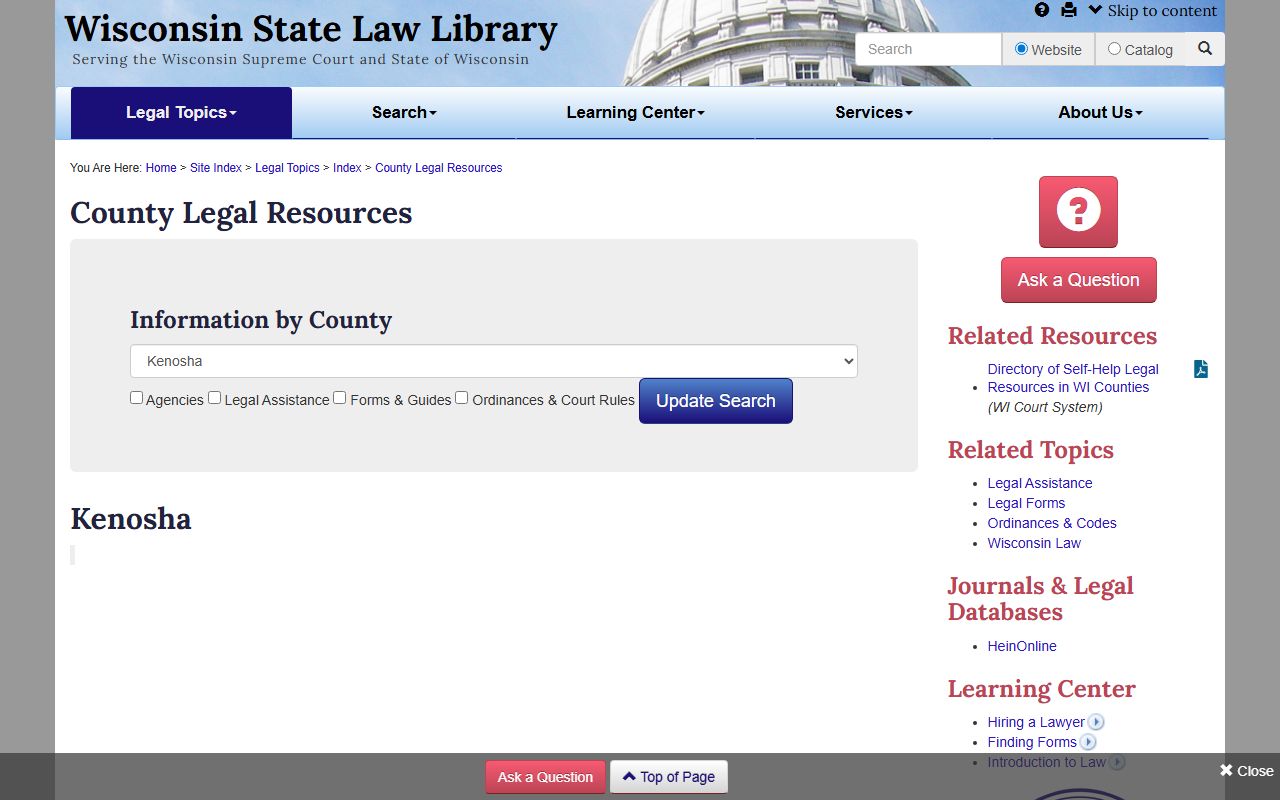
That directory is useful because it keeps the county court offices together instead of forcing you to guess at the right door. When a search starts with a name, a citation, or a rough filing year, the page helps you decide whether the next step belongs with the clerk, the sheriff, or the district attorney.
The clerk can help you find the record and the form path, but the office cannot give legal advice. That line matters in a DUI search. You can ask for a copy, a certified copy, or help finding an older docket, but the clerk will not tell you how to fight the case. If you already know the case number, the clerk can usually move faster. If you do not, the party name and filing year are the next best clues.
Bring these details when you ask for a record:
- Full name of the defendant or party
- Approximate filing year
- Case number or citation number, if you have it
- Whether you need a copy, a certified copy, or a docket check
Note: The clerk can show you the official record path, but legal advice still belongs with an attorney or another qualified adviser.
Kenosha County WCCA Search
The first online stop for most Kenosha County DUI searches is Wisconsin Circuit Court Access. WCCA provides free public access to circuit court case records for all 72 Wisconsin counties, and Kenosha County is the fourth most populous county in Wisconsin, so it sees a significant volume of court cases. You can search criminal OWI cases, traffic matters, civil cases, family cases, and other circuit court files by party name, business name, case number, or date range.
WCCA gives you the outline, not the full packet. You can see docket activity, case status, the judge assigned, and the history of hearings and filings, but not every document attached to the file. That is why the Kenosha County Clerk of Courts still matters after the online search is done. Once the docket gives you the case number, the clerk can help with copies, certification, and older records. WCCA tells you what happened. The clerk gives you the record that proves it.
WCCA searches work best with exact details. A full name helps. A citation number helps more. If the file is old or the spelling is uncertain, the filing year keeps you from pulling the wrong person or the wrong case. Kenosha is large enough that common names can return more than one result, so the cleaner the search input, the less time you spend sorting through noise. Note: WCCA shows the docket, but not every attachment or sealed filing.
Kenosha County Sheriff and DA
The Kenosha County Sheriff's Department can be reached at 262-605-5100. The county research says the office provides county law enforcement and jail operations, and that it executes and serves legal documents such as restraining orders, evictions, repossessions, and foreclosure sales. Warrant information can be obtained through the sheriff's office. For a DUI search, that makes the sheriff the county source for the arrest layer, the custody layer, and any warrant issue that sits outside the court docket.
The sheriff's office matters when a DUI case involves a booking, a transfer, or a live warrant. If the record started with a stop and not a court date, the sheriff side is often the first county record that matters. It can also help you tell whether the person is in custody, whether service has happened, and whether the file has moved into the court system yet.
The Kenosha County District Attorney can be reached at 262-653-2400. The office prosecutes criminal cases, including OWI offenses, and Kenosha County Victim/Witness Services uses the same number. If you need to know whether a charge was filed, amended, or resolved, the district attorney is the office that usually answers that layer. The county also lists a Kenosha County Legal Clinic at 262-652-5545, which offers volunteer attorney advice on the first and third Fridays of each month for people who need help understanding forms or next steps.
That split matters. The sheriff tells you what happened on the street or in the jail. The district attorney tells you how the county treated the charge. The clerk tells you what the court file says. Put them together and the Kenosha County DUI record becomes much easier to read.
Kenosha County DUI Follow-Up
Kenosha County DUI Records do not always begin in circuit court. If the matter started as a city citation or a municipal court case, the Kenosha Police Department records path can matter too. The county research says requests can be sent to the Records Department at 1000 55th Street, Kenosha, WI 53140, by mail, by email at records@kenoshajs.org, or by fax at 262-653-6909. The department asks for 10 working days to respond, and reports can be mailed or picked up at the Public Safety Building's Information Counter. That local step can explain why a DUI search starts in more than one place.
State tools fill in the gaps that county and city files do not cover. A WisDOT driving record request shows license status, violations, suspensions, revocations, and OWI history. The request costs $5 per record online or by mail, and third-party requests require the driver's authorization. If the real question is when a person can drive again, the WisDOT OWI suspension page explains revocation periods, occupational licenses, SR22 insurance, and ignition interlock requirements.
The Wisconsin State Law Library's drunk driving resources gather the main legal references in one place. The core offense language is in Wis. Stat. 346.63, and the implied consent and chemical testing rules are in Wis. Stat. 343.305. If you want a broader criminal history check, the Wisconsin Online Record Check System can help with the statewide layer. If the case involved a crash, the WisDOT crash records system adds the accident-report piece, and the Wisconsin eFiling portal can be the filing path for motions or other court papers.
Kenosha County DUI Records make the most sense when you read them in layers. WCCA shows the case. The clerk keeps the official court record. The sheriff shows the arrest and custody trail. The district attorney shows the charging and prosecution trail. The city or state record systems fill in the driver license, crash, and municipal details. Once those pieces are separated, the search becomes easier to follow and much easier to trust.
Reading the Kenosha County Trail
The cleanest way to read Kenosha County DUI Records is to put the pieces in order. Start with WCCA to confirm the docket. Then use the clerk for the official court file. After that, check the sheriff for the arrest or jail layer, the district attorney for the charging layer, and the city police records office if the matter began as a municipal citation. If the question is about driving privileges, the DOT record and the OWI suspension page carry more weight than the court docket alone.
Use these search clues:
- Party name or defendant name
- Case number or citation number, if known
- Approximate filing year
- Whether the matter looks like OWI, traffic, arrest, or a city citation
Kenosha County DUI Records become much easier to trust once you separate the public docket from the official file and the license history. That way you can tell whether you are looking at a pending case, a closed case, or a separate driving problem that still needs state action.
Note: Municipal records and circuit court records are separate systems, so a city citation may not show the same way as a county OWI case.